
How BlueLabs is Innovating Election Modeling
Our data science team is constantly innovating to better understand the electorate and help our clients make informed decisions about the state of the race and who their voters are.
During the 2026 election cycle, our team was excited to be involved in some of the most consequential races in the country. We built bespoke support models and provided data services for dozens of statewide and congressional races, including Gina Hinojosa and James Talarico in Texas, and helped support winning races for Senate and Congress from Mississippi to Alaska and Arizona to New York.
The team also developed a suite of models to identify voters most at risk of having their vote not counted, so organizations could conduct outreach and educational campaigns to ensure every voter was heard.
This cycle, we took a fresh look at how we build our core models, including our candidate support scores and voter turnout prediction models. We incorporated new data sources from our proprietary Ripple dataset and applied advanced modeling techniques to better identify patterns in the data.
Our election night reporting got revamped, too, creating up-to-the-minute predictions for every major race that helped us identify trends early and tell the story of the night as results came in.
Now that the election is over, we’re comparing our predictions with actual results to understand what drove shifts in the electorate, and what we can improve for future elections.
What we’re learning from the 2026 election
Post-election analysis gives us an opportunity to validate how well our models performed, understand the factors driving election outcomes, and identify opportunities to further refine our predictions.
We’ve been comparing county-level election results with our predictions, as well as gathering precinct-level results and updated voter files. Georgia’s voter file, for example, already includes 2026 turnout information, giving us an early look at individual voter participation.
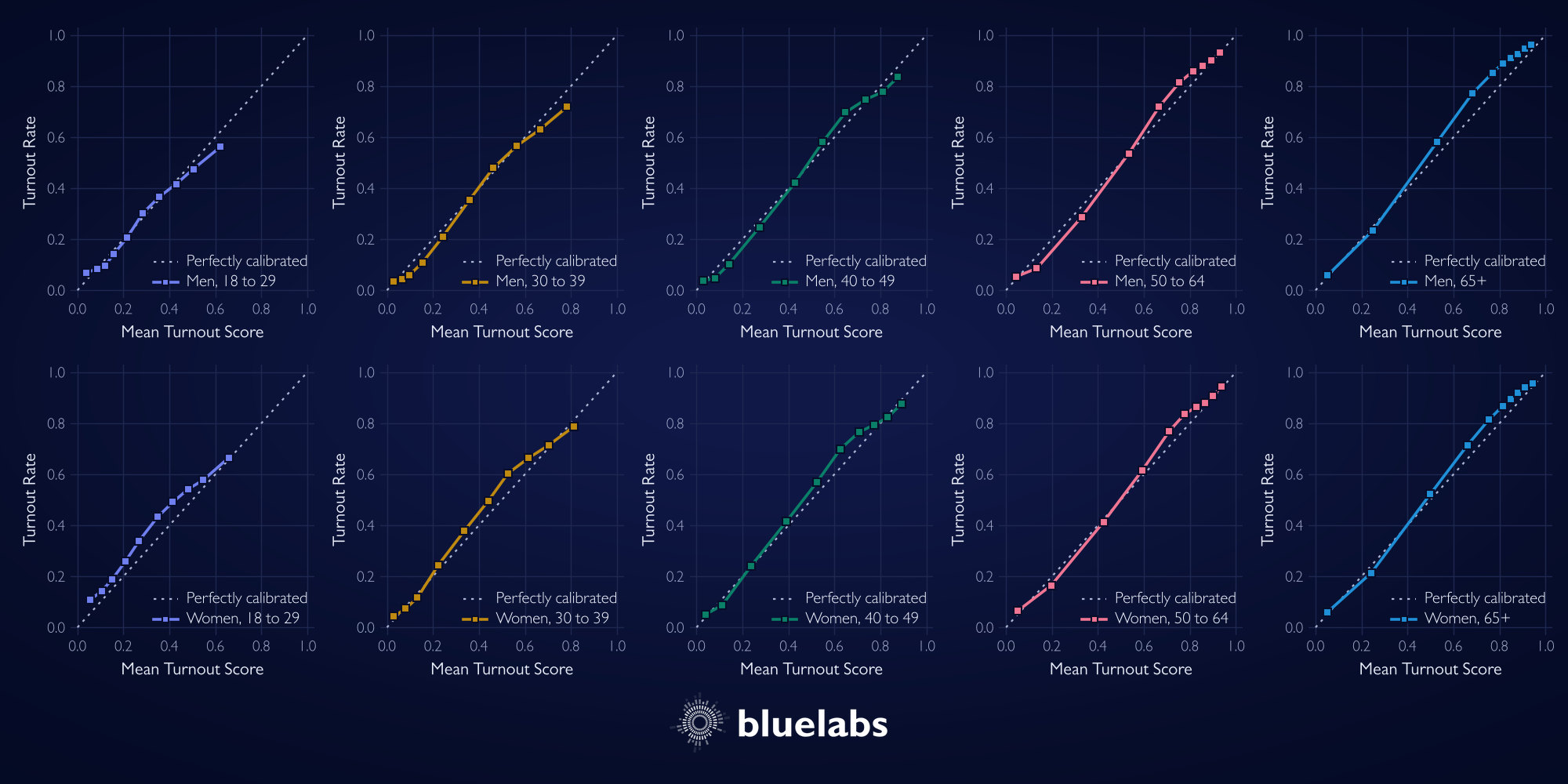
So far, our models have performed really well, particularly in ranking voters by their likelihood to turn out and support specific candidates. In counties across the country with complete precinct reporting, our turnout model was within two points of the final turnout rate in an election where votes were up more than 12%, which meant that we were accurately capturing the increased enthusiasm to vote. In Georgia, where we already knew exactly who voted, the model was even closer, predicting turnout at 49.4% of registered voters versus actual turnout at 50.9%.
Our support models closely mirrored actual election night results in some of the country’s most important races. For example, this chart shows county-level reported support in four of the most watched races, tracking closely with our predicted levels of support.
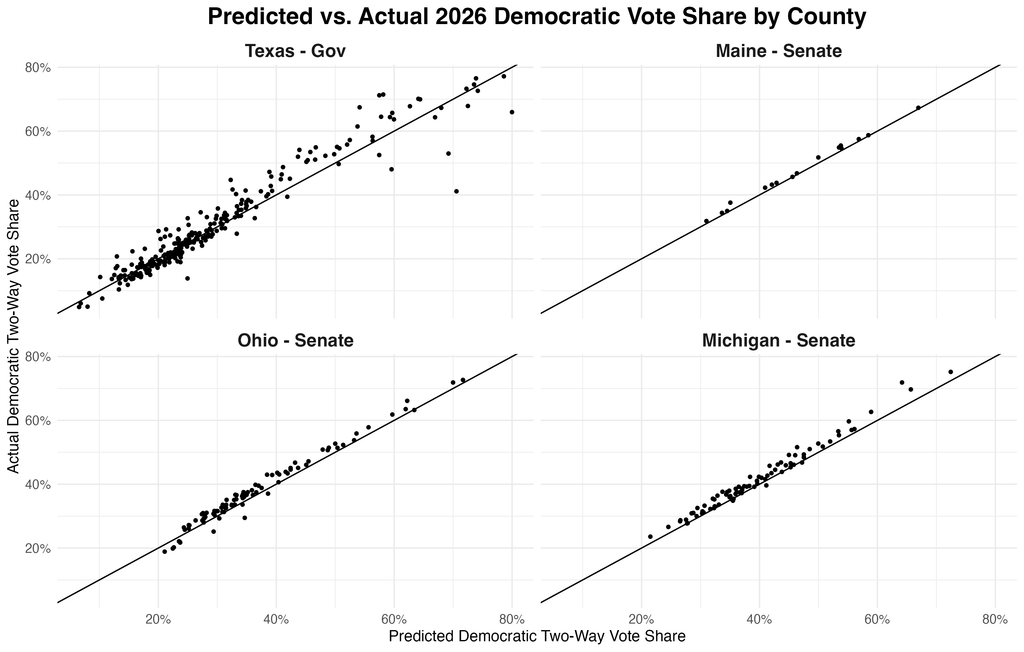
Our election night model quickly identified demographic trends driving Democratic overperformance, providing early insights before full results were available. In Texas, for example, the model was within roughly 1% of the final by 8:30 p.m. ET (30 minutes after polls closed) when the AP called the race at 11:17 p.m. ET. In addition, we predicted Peltola’s first round victory days before the AP called the race.
What this means for our clients and future campaigns
BlueLabs models help campaigns understand voters’ beliefs, anticipate turnout, and make informed decisions about outreach strategy. Through rigorous statistical modeling and validation, we work to ensure these insights reflect what’s happening in the electorate, giving clients greater confidence in their decisions.
We’re already starting to plan for what’s next, including how to deploy our election night reporting tools for the upcoming primaries and what tools will be most valuable for our clients to build on the successes of this year’s election.
Each election provides new data and opportunities to strengthen our approach, and we’re looking forward to applying what we’re learning to the races ahead.